

How Do Landlords Cope With Mortgage Interest Increases?
For many landlords, the biggest question isn't “Can I increase the rent?”
It's:
“How do I keep my rental property financially sustainable when my mortgage costs increase?”
Mortgage interest rates have changed significantly over recent years, putting pressure on landlords' cash flow and overall returns.
The Bank of England has previously highlighted that buy-to-let landlords can be particularly exposed to higher interest rates because a large proportion of buy-to-let mortgages are interest-only.
So, when mortgage costs rise, what can landlords actually do?
There isn't one answer.
Different landlords respond in different ways depending on their mortgage, property, rental income, tax position and long-term plans.
1. Some landlords increase the rent
One of the most obvious ways landlords may respond to higher mortgage costs is by reviewing the rent.
And this is something we have seen more of in recent years.
The English Private Landlord Survey 2024 found that 29% of landlords who increased the rent for their most recent new let said mortgage costs or lender requirements were one of the reasons. This was up from 11% in 2021.
But there is an important distinction:
A landlord's mortgage cost does not automatically determine the market rent.
Rent still needs to reflect what tenants are willing and able to pay for a property in that particular area.
If a landlord increases the rent too far above the local market, they could face a longer void period — potentially cancelling out some of the benefit of the higher rent.
This is why landlords need to look at comparable local properties and current demand, rather than simply adding their increased mortgage cost to the rent.
2. Some landlords absorb the increase
Not every landlord passes higher mortgage costs directly onto their tenant.
Some choose to absorb some or all of the increase.
Why?
Because keeping a good tenant can have financial value too.
A landlord needs to consider the cost of:
- Finding a new tenant
- Advertising
- Referencing
- Cleaning
- Repairs
- Redecoration
- Possible void periods
- Professional management
- Time spent dealing with a new tenancy
Sometimes, a slightly lower rent with a reliable long-term tenant can make more financial sense than constantly trying to achieve the highest possible rent.
At My Landlord Cares, this is why we believe renting should be viewed as a relationship as well as a financial arrangement.
You can read more about our approach on our landlord property management page.
3. Landlords review their mortgage
Another option is to review the mortgage itself.
When a fixed-rate mortgage comes to an end, landlords may look at:
- Remortgaging
- Alternative lenders
- Different fixed-rate products
- The length of the mortgage term
- Interest-only versus repayment arrangements
- Whether additional borrowing is appropriate
The right choice depends entirely on the landlord's circumstances.
It is also worth starting the conversation early.
The Government's 2026 Mortgage Charter says participating lenders provide certain support options for eligible regulated residential mortgage borrowers, including the ability to lock in a deal up to six months before an existing fixed rate ends.
Important: the Mortgage Charter is primarily aimed at regulated residential mortgage borrowers, so landlords should check whether a particular mortgage and lender arrangement is covered rather than assuming the same protections apply to a buy-to-let mortgage.
4. They look closely at their costs
When mortgage interest rises, every other cost becomes more important.
Landlords may review:
Insurance → Maintenance → Management fees → Utilities during voids → Licensing → Compliance → Repairs
The objective isn't necessarily to cut everything.
It is to understand where money is being spent and whether the property is being managed efficiently.
For example, a landlord might discover that small maintenance issues are becoming expensive because they are being left until they turn into larger problems.
Good property management can therefore become even more important when margins are under pressure.
Our property management services are designed around proactive management, communication and helping landlords manage the day-to-day responsibilities of renting out property.
5. They consider the tax position
Mortgage interest and tax can be a complicated area for individual residential landlords.
For individual landlords, mortgage finance costs are generally dealt with through the finance cost relief rules rather than simply being deducted from rental income in the same way as many ordinary property expenses.
HMRC's current guidance explains the rules around residential property finance costs.
The Government has also announced separate property-income tax rates from April 2027, with finance cost relief provided at the property basic rate of 22%.
This is an area where landlords should get individual tax advice, particularly where they own multiple properties or operate through a company.
6. Some landlords change their investment strategy
When the numbers no longer work, some landlords reconsider their portfolio.
That might mean:
- Keeping the property
- Selling one property
- Reducing borrowing
- Buying a different type of property
- Investing in a different area
- Changing the way the property is managed
The English Private Landlord Survey 2024 found that mortgage payments were among the financial concerns reported by landlords, alongside issues such as repairs and rent arrears.
This doesn't mean that every landlord is struggling.
But it does show why landlords need to regularly review the financial performance of their properties.
The biggest mistake: looking at mortgage costs in isolation
A property isn't profitable simply because:
Rent > Mortgage
There are many other costs.
For example:
Rental income
− Mortgage interest
− Management fees
− Repairs
− Insurance
− Licensing
− Compliance
− Void periods
− Maintenance
− Tax
= Actual return
This is why landlords need to look at the whole picture.
A property that looked highly profitable several years ago may have a very different financial position today.
Should landlords increase rents when mortgage costs rise?
There isn't a universal answer.
A landlord needs to consider both their own costs and the market.
If similar properties are renting for £1,000 per month, increasing the rent to £1,200 simply because the landlord's mortgage has increased may not work.
The landlord could end up with a vacant property.
On the other hand, if the local market has moved to £1,100, failing to review the rent for years could also leave the landlord carrying unnecessary costs.
It's about finding the balance between:
Fair rent + sustainable landlord costs + realistic market conditions.
Good tenants can be part of the solution
This is something we believe strongly at My Landlord Cares.
When mortgage costs rise, landlords understandably focus on their finances.
But the tenant is part of that financial equation too.
A good tenant who pays on time, looks after the property and wants to stay can provide stability.
And stability has value.
Reducing unnecessary voids, dealing with repairs quickly and communicating properly can help landlords protect their income while giving tenants a better renting experience.
Property management isn't just about collecting rent.
It's about protecting the relationship that makes the rental income possible.
So, how do landlords cope with mortgage interest increases?
There isn't one magic solution.
Landlords may:
🏠 Review their rent against the local market
💷 Review mortgage options
📊 Analyse property profitability
🔧 Control unnecessary maintenance costs
🤝 Focus on good tenant relationships
📋 Improve property management and compliance
💰 Review their wider tax position
🏘️ Reassess their portfolio and long-term strategy
The important thing is to look at the whole picture rather than making a knee-jerk decision.
For some landlords, the answer may be a rent review.
For others, it may be better mortgage planning, improved management or simply accepting a lower short-term return while maintaining a strong tenancy.
And sometimes, the numbers may lead a landlord to reconsider whether a particular property still fits their investment strategy.
Final thoughts from My Landlord Cares
Landlords are facing a very different financial environment from the one many entered the market in.
Mortgage costs, regulation, maintenance, insurance and compliance all need to be considered alongside rental income.
But there is another side to the equation.
Landlording is a business — but renting is a human experience.
The most sustainable approach isn't always about charging the maximum possible rent.
It's about managing the property properly, understanding the market, controlling costs and building a tenancy that works for both sides.
At My Landlord Cares, that's what we mean when we say:
Property management done properly.
Useful external links
For landlords wanting to understand the wider mortgage environment:
- Bank of England – Buy-to-let sector and financial stability
- GOV.UK – English Private Landlord Survey 2024
- GOV.UK – Mortgage Charter 2026
- GOV.UK – Mortgage finance costs and tax relief
Disclaimer
Disclaimer: This article is for general information purposes only and does not constitute legal, financial, mortgage or tax advice. Mortgage products, interest rates, taxation and landlord regulations can change, and the financial position of each landlord is different. Landlords should seek independent advice from a qualified mortgage adviser, accountant or other appropriate professional before making financial or property decisions.

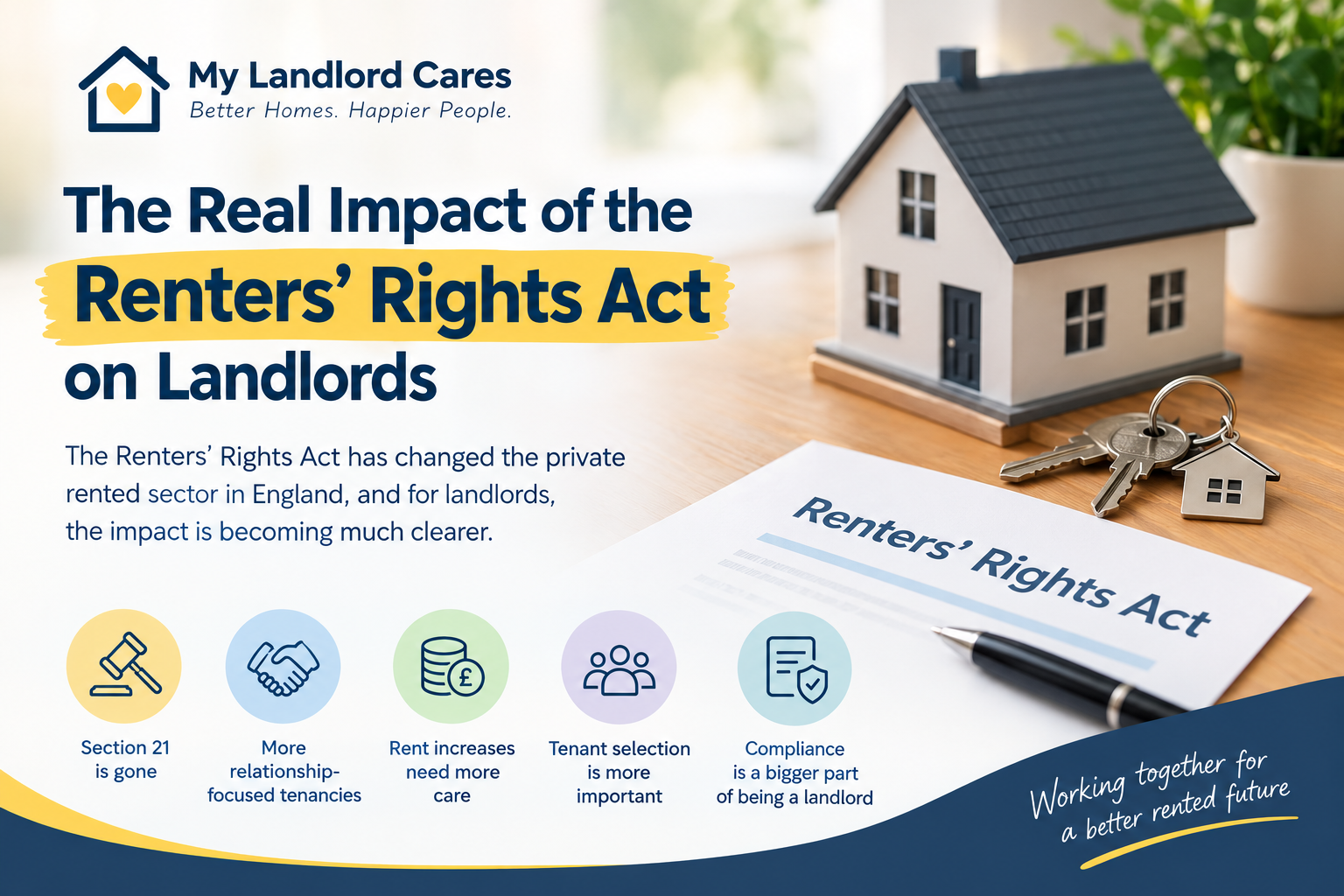
The Real Impact of the Renters’ Rights Act on Landlords
The Renters’ Rights Act has changed the private rented sector in England, and for landlords, the impact is becoming much clearer.
Since 1 May 2026, landlords have had to adapt to significant changes, including the end of Section 21 “no-fault” evictions, the move to assured periodic tenancies and new rules around rent increases.
But what does this actually mean for landlords on the ground?
Is it simply more regulation?
Or could it also change the way landlords manage properties, choose tenants and build longer-term relationships?
At My Landlord Cares, we think it is worth looking beyond the headlines.
What has actually changed?
The Renters’ Rights Act introduced some of the biggest changes to private renting in decades.
From 1 May 2026:
- Section 21 “no-fault” evictions were abolished.
- Most existing and new assured shorthold tenancies became assured periodic tenancies.
- Tenants can generally end their tenancy with two months’ notice.
- Landlords need a valid legal ground when seeking possession.
- New rules apply to rent increases.
- Tenants have greater protections around certain practices, including restrictions on rental bidding and excessive rent in advance.
For landlords, this means that good systems and good property management matter more than ever.
1. Section 21 is gone — possession needs a valid reason
Perhaps the most significant change for landlords is the abolition of Section 21.
Previously, Section 21 allowed landlords to seek possession without having to establish a specific reason, provided the legal requirements were met.
That route is no longer available.
Landlords now need to rely on the relevant possession grounds under Section 8.
This doesn't mean landlords have lost the ability to regain possession of their property. It means the reason and process matter much more.
For landlords, accurate records, documentation and compliance are therefore increasingly important.
2. Tenancies are becoming more relationship-focused
The move towards periodic tenancies changes the dynamic between landlords and tenants.
Instead of simply thinking about a tenancy as a fixed contract with a defined end date, landlords need to think more about:
“How do I create a tenancy that works for both sides?”
That means communication matters.
Repairs matter.
Tenant support matters.
And dealing with problems early matters.
This is something we have always believed at My Landlord Cares.
Our approach focuses on supporting tenants to settle and stay, with proactive communication and additional support designed to help create longer, more stable tenancies.
You can read more about our approach on our property management services for landlords.
3. Rent increases need more care
Another important change concerns rent increases.
Under the new rules, landlords must follow the Section 13 process when increasing rent on an assured periodic tenancy.
A tenant can challenge an increase if they believe it is above the open-market rent, with the First-tier Tribunal able to determine the rent in certain circumstances.
For landlords, this makes good market evidence increasingly important.
Before increasing rent, it makes sense to look at:
- Comparable properties
- Current local rents
- Property condition
- Location
- Size and facilities
- Demand in the local market
- The existing tenant relationship
A rent increase should not simply be based on what a landlord needs to cover their costs.
The market ultimately matters too.
4. Tenant selection is becoming even more important
One of the interesting consequences of the reforms is that some landlords are becoming more cautious about who they let to.
Research published by the National Residential Landlords Association (NRLA) in May 2026 found that 78% of surveyed landlords said the Act was likely to make them more selective about who they rent to.
This raises an important issue.
If landlords become overly cautious, some tenants who already find renting difficult could potentially face even greater barriers.
For example, people with:
- Irregular income
- Limited credit history
- No UK guarantor
- Previous financial difficulties
could find it harder to secure a property.
This is why we believe tenant-centred vetting is important.
Landlords need protection, but good tenants shouldn't automatically be excluded because they don't fit a traditional checklist.
5. Compliance is becoming a bigger part of being a landlord
The Renters’ Rights Act doesn't exist in isolation.
Landlords are operating in an environment where legislation, safety requirements, licensing and energy efficiency expectations are becoming increasingly important.
The result?
Being a landlord is becoming more professionalised.
That means landlords need systems for:
Compliance → Repairs → Documentation → Rent collection → Communication → Inspections → Record keeping
The days of simply collecting rent and calling someone when something goes wrong are becoming increasingly difficult.
And honestly, that's not necessarily a bad thing.
Professional property management can help landlords stay organised while allowing them to focus on the investment rather than the day-to-day administration.
6. The financial impact isn't just about rent
When people talk about the impact of the Renters’ Rights Act, they often focus on rent.
But the bigger financial question may be risk.
Landlords need to consider:
- Potential void periods
- Maintenance costs
- Legal and compliance costs
- Time spent managing disputes
- Possession proceedings
- Rent arrears
- Professional management fees
- Property improvements
- Changing tenant demand
The latest NRLA Landlord Eye report, based on responses from 992 landlords, found that landlord confidence remained close to a record low in Q2 2026. The report also found that 26% of respondents said they had sold or were currently selling property because of the Renters’ Rights Act, while a further 19% were considering selling.
These are survey findings from NRLA members, rather than evidence that every landlord is experiencing the same outcome. But they do show that the legislation is influencing some landlords' decisions.
So, is the Renters’ Rights Act bad for landlords?
The answer isn't quite that simple.
The Act creates additional responsibilities and changes the way landlords operate.
But the impact will vary depending on the landlord.
A landlord with poor documentation, slow repairs and weak processes may experience the changes very differently from a landlord who already operates professionally.
In our view, the bigger shift is this:
The role of the landlord is becoming more professional.
Landlords need to understand the law.
They need reliable systems.
They need to communicate properly.
They need to maintain their properties.
And they need to understand that the tenant relationship is part of managing the asset.
At My Landlord Cares, our philosophy has always been that supporting tenants can also support landlords.
Longer tenancies can reduce voids.
Good communication can prevent problems escalating.
Responsive repairs can protect the property.
And treating people properly can build stronger relationships.
You can read more about how My Landlord Cares supports both landlords and tenants.
What should landlords do now?
If you are a landlord in England, the practical response should be to review your systems.
A simple landlord checklist:
✅ Review your tenancy agreements and processes.
✅ Understand the new possession grounds.
✅ Make sure your rent-increase procedures are compliant.
✅ Keep accurate records.
✅ Review your property compliance.
✅ Make sure repairs are dealt with promptly.
✅ Review your tenant communication process.
✅ Keep evidence supporting proposed market rents.
✅ Consider whether your current property management system is robust enough.
If you manage several properties, it may also be worth reviewing whether you have the time and expertise to keep up with the changing requirements.
Our landlord property management service covers areas including compliance, rent collection, rent increases, tenancy support and property management.
The bigger picture
The Renters’ Rights Act represents a significant change for the private rented sector.
For tenants, it provides greater security and new protections.
For landlords, it means adapting to a system where process, professionalism and tenant relationships are increasingly important.
The real impact may therefore go beyond individual pieces of legislation.
It could change what it means to be a landlord in England.
At My Landlord Cares, we believe property management should work for both landlords and tenants.
Because ultimately, a rental property isn't just an asset.
It's someone's home. 🏠
And when landlords and tenants are supported properly, better outcomes can follow for everyone.
Useful external resources
For landlords wanting to understand the legislation directly, the UK Government's Renters’ Rights Act guidance for landlords provides the official overview.
The Government's Renters’ Rights Act implementation roadmap explains how the reforms are being implemented.
Landlords can also read the NRLA's latest Landlord Eye research for survey-based information about landlord confidence and experiences following the first phase of implementation.
Disclaimer
Disclaimer: This article is for general information purposes only and does not constitute legal, financial, tax or professional advice. The Renters’ Rights Act and related regulations may be subject to further guidance, amendments and changes. Landlords should check the latest information from GOV.UK and seek independent professional advice about their individual circumstances before taking action.

Finding the Right Tenant Takes Time: Why Landlords Should Focus on Quality, Not Speed
Every landlord wants the same thing:
A good tenant, paying rent on time, looking after the property and staying for the long term.
However, finding the right tenant does not always happen overnight.
A common conversation between landlords and letting agents often looks like this:
Week 1:
“Can we fill my rental as soon as possible?”
Week 2:
“Why is it taking so long?”
Week 3:
“This is taking too long.”
We completely understand why landlords feel pressure.
A vacant property means lost rental income, and every landlord wants their investment working efficiently.
But finding the right tenant requires more than simply placing someone into a property.
We Understand the Pressure Landlords Feel
As a small independent property business, we understand that every empty day matters.
A vacant property can create concerns about:
- Lost rental income
- Mortgage payments
- Utility costs
- Maintenance expenses
- Investment returns
That is why our team works extremely hard to support landlords.
Our team regularly works around the clock to:
- Respond to enquiries
- Arrange viewings
- Communicate with applicants
- Process applications
- Coordinate with landlords
- Keep properties moving forward
However, we also believe in being honest:
We are hardworking, but we are not miracle makers.
The Rental Market Is Seasonal
One important factor landlords need to consider is that rental demand changes throughout the year.
During periods of extreme weather, school holidays and summer travel, there can be a natural slowdown in viewing activity.
Many potential tenants may delay moving because:
- Families are managing school holidays
- People are travelling
- Moving house during hot weather can be challenging
- Tenants prefer to wait until their schedules are clearer
This does not mean there is no demand.
It simply means the right tenant may take longer to find.
Understanding seasonal rental patterns helps landlords make realistic decisions.
Why We Do Not Just Accept Anyone
Sometimes the quickest solution is not always the best solution.
A landlord may think:
“Can we just get someone moved in?”
But placing the wrong tenant can create much bigger problems later.
A poor tenant match can lead to:
- Rent arrears
- Property damage
- Complaints
- Disputes
- Stress for landlords
- Additional costs
This is why tenant selection matters.
A good tenant should:
✔ Pass appropriate checks
✔ Be able to afford the rent
✔ Understand their responsibilities
✔ Look after the property
✔ Communicate effectively
The goal is not just to fill a property.
The goal is to create a successful long-term tenancy.
Quality Tenants Take Time
A proper tenant-finding process involves several stages:
- Marketing the Property
The property needs to be presented correctly with:
- Quality photographs
- Accurate descriptions
- Clear rental information
- Effective advertising
Good marketing helps attract suitable applicants.
You can view examples of our current rental listings through our available properties page.
- Arranging Viewings
Viewings require coordination between:
- Landlords
- Agents
- Applicants
- Existing tenants (where applicable)
Our team works hard to accommodate viewing requests and keep communication flowing.
- Tenant Referencing
Finding a tenant is not only about interest in the property.
Applicants usually need to complete checks such as:
- Identity verification
- Income assessment
- Employment checks
- Previous landlord references
- Right to Rent checks
The official GOV.UK Right to Rent guidance explains the checks required before renting property in England.
Managing Landlord Expectations
We believe communication is key.
We keep landlords updated throughout the process and explain:
- How many enquiries have been received
- Viewing activity
- Applicant feedback
- Current market conditions
- Any challenges affecting demand
Sometimes the property may need:
- A pricing review
- Improved marketing
- Additional advertising
- More time to reach the right audience
Being proactive helps landlords make informed decisions.
Small Business, Big Commitment
As a small business, we may not have the resources of a large corporate organisation.
But what we do have is:
❤️ A committed team
❤️ A personal approach
❤️ Strong communication
❤️ A genuine desire to help landlords succeed
Our team works incredibly hard every day to support landlords and tenants.
We do not just want to fill properties.
We want to build successful tenancies that benefit everyone involved.
Learn more about our property management services for landlords.
You can also explore our property management pricing or contact My Landlord Cares to discuss your property.
Final Thoughts
A vacant property can be stressful, and we understand why landlords want quick results.
But speed should never come at the expense of quality.
The right tenant may take a little longer to find, but a successful tenancy can save landlords significant time, money and stress in the future.
At My Landlord Cares, we will continue working hard, communicating honestly and doing everything possible to support our landlords.
We cannot promise miracles.
But we can promise commitment, transparency and a team that genuinely cares.
Disclaimer
This article is provided for general information and educational purposes only. It does not constitute legal, financial, housing or investment advice. Rental demand, market conditions and tenant availability can change depending on location, season and economic factors. Landlords should consider professional advice and local market conditions when making decisions about their property.

How Interest Rates Are Impacting Buy-to-Let in 2026
As we move into 2026, landlords across the UK are facing the challenges posed by fluctuating interest rates, which are having a significant impact on the buy-to-let (BTL) market. With the Bank of England’s interest rate hikes, many landlords are feeling the pressure of rising borrowing costs. In this blog, we’ll explore how these changes are affecting the buy-to-let market and what landlords can do to adapt.
- The Impact of Rising Interest Rates on Buy-to-Let
Interest rates have been rising steadily since 2022, and in 2026, these changes are continuing to affect the financial landscape for landlords. Higher interest rates mean increased mortgage repayments for buy-to-let investors, especially for those with variable-rate or tracker mortgages.
According to a BBC article on UK rental trends, higher borrowing costs are leading to squeezed profit margins for many landlords. With the cost of mortgages rising, it’s becoming more difficult to maintain profitability on rental properties, especially in areas where rents haven’t been able to keep up with the increased mortgage payments.
- What Landlords Should Do in Response to Rising Interest Rates
If you’re a landlord concerned about the impact of rising interest rates, here are several steps you can take to manage the situation and protect your rental income:
- Review Your Mortgage Terms
If you haven’t already, it’s important to review your mortgage terms and consider remortgaging to secure a more favorable fixed-rate deal. Many landlords with variable-rate mortgages are finding themselves paying higher monthly repayments. By locking into a fixed-rate mortgage, you can protect yourself from future rate hikes.
For expert advice on mortgage options and how to make the best financial decisions for your rental property, check out our Property Finance Guide.
- Increase Rent Carefully
While rent increases may seem like an obvious solution, landlords should be cautious about overpricing. Rising rents could make your property less attractive to potential tenants, especially in competitive markets. However, where possible, adjusting rent in line with market rates can help offset the increased costs of your mortgage.
Explore more about rent adjustment strategies by visiting our Landlord Advice blog.
- Consider Short-Term Lets
If your property is located in a high-demand area, you may want to explore the possibility of renting it out as a short-term let. Short-term rentals, such as those listed on platforms like Airbnb, can often generate higher returns compared to long-term rentals. However, this approach requires more management and maintenance, so it may not be ideal for every landlord.
Learn more about the pros and cons of short-term lets by reading our Short-Term Letting Guide.
- Improve Property Efficiency
Rising interest rates can cut into your profits, but reducing operating costs can help protect your margins. Consider making energy efficiency upgrades to your property, such as installing double glazing, upgrading insulation, or switching to energy-efficient appliances. Not only will these changes make your property more attractive to tenants, but they will also help reduce utility costs.
Visit our Property Maintenance Services for tips on making your rental property more energy-efficient.
- Long-Term Considerations for Buy-to-Let Investors
For landlords looking to stay competitive in the long run, there are several strategies to consider as part of your overall investment plan:
- Diversify Your Portfolio: Rather than focusing on just one property, diversify your investments across different locations or property types. This can help spread the risk if one area becomes less profitable due to interest rate changes or other economic factors.
- Stay Informed: Keep track of market trends and interest rate forecasts. Understanding the direction of the market will help you make informed decisions about your portfolio and future investments.
For more tips on building a sustainable property portfolio, check out our Investment Tips for Landlords
Disclaimer
The information provided in this blog is for general informational purposes only. MyLandlordCares.co.uk cannot be held responsible for any damages or losses arising from the use of the information provided. Always consult with a professional financial advisor or mortgage expert when making decisions related to your buy-to-let investments.
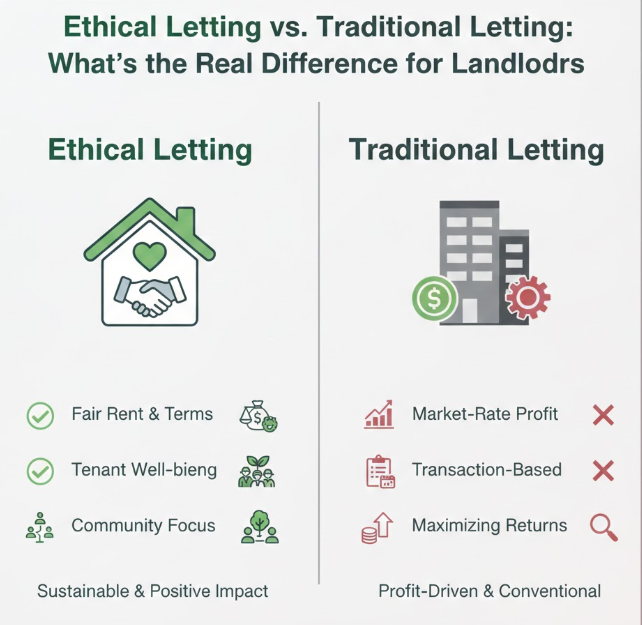
Ethical Letting vs. Traditional Letting: What’s the Real Difference for Landlords?
When choosing a letting agent, landlords often face a tough decision: go with a traditional agency or work with an ethical letting agent. But what does that really mean, and how does it affect your rental business?
At My Landlord Cares, we’re not just landlords — we manage properties ethically, transparently, and with both tenants’ and landlords’ best interests at heart. Here’s why ethical letting matters.
🔹 1. Transparency and Trust
Traditional agents may focus primarily on profit, sometimes hiding fees or cutting corners. Ethical letting agencies operate openly:
- Clear, upfront fees
- Regular updates on property and tenant status
- Honest advice on rent, maintenance, and compliance
This builds landlord trust, reduces surprises, and strengthens long-term relationships.
🔹 2. Tenant-Focused Management
Ethical letting agents prioritise tenants as well as landlords. Why? Because happy tenants stay longer. This leads to:
- Reduced void periods
- Fewer disputes and complaints
- Better care for the property
By looking after tenants, ethical agents indirectly protect your investment and maximise returns.
🔹 3. Compliance and Legal Safeguards
Regulations in the UK rental market are strict. Ethical letting agents stay up to date with:
- Gas and electrical safety requirements
- Deposit protection schemes
- Local licensing rules
- Changes in rental law
This helps landlords avoid fines and maintain smooth operations.
🔹 4. Ethical Agencies Focus on Long-Term Results
Traditional agents often focus on short-term gains: quick lets and high fees. Ethical letting agents focus on sustainable, long-term performance:
- Strong tenant relationships
- Transparent financial reporting
- Regular property maintenance
- Investment growth strategies
The result? Safer, more profitable property management for landlords.
🔹 5. Working With My Landlord Cares
At My Landlord Cares, we combine the benefits of ethical property management with our own landlord experience. Our approach ensures your property is looked after, tenants are supported, and your investment grows sustainably.
Learn more about professional standards for ethical letting and property management here:
👉 Propertymark – Ethical Property Management
🟦 Ready to Experience Ethical Letting?
Switching to an ethical letting agent could transform the way your property performs.
👉Discover Our Landlord Services
Get in Touch
⚠️ Disclaimer
This blog provides general guidance on property management and ethical letting. It does not constitute legal, financial, or professional advice. Landlords should seek expert advice for specific situations or compliance matters.

How We Reduce Void Periods for Our Landlords in Sheffield
Void periods — the gaps when your property sits empty — are one of the biggest headaches for landlords. Every week without a tenant is lost income, potential maintenance issues, and extra stress. At My Landlord Cares, we help landlords avoid void periods in Sheffield and protect their rental income.
Here’s how we do it.
🔹 1. Proactive Marketing and Tenant Matching
We ensure properties are advertised effectively across multiple channels to attract the right tenants quickly.
- Professional photos and detailed listings
- Strong tenant screening to ensure reliability
- Matching tenants to properties that suit their lifestyle
The result? Less downtime and longer tenancies, which protect your rental income.
🔹 2. Transparent and Responsive Communication
When tenants have questions or concerns, we act fast. Clear communication prevents misunderstandings, reduces the chance of early terminations, and keeps tenants happy.
🔹 3. Regular Property Maintenance
Properties that are well-maintained attract and retain tenants. We proactively schedule inspections and repairs so your home is always in top condition.
🔹 4. Flexible Tenancy Solutions
Sometimes, letting gaps are unavoidable. We offer solutions like:
- Short-term lettings to bridge voids
- Pre-letting strategies before current tenants leave
- Seasonal rental planning for peak demand periods
🔹 5. Ethical Landlording That Builds Trust
Tenants stay longer when they feel supported. At My Landlord Cares, our ethical approach ensures tenants are cared for, reducing the likelihood of void periods and protecting your investment.
📈 Protecting Rental Income Sheffield Landlords Can Rely On
By combining proactive marketing, regular maintenance, and tenant-focused management, we help landlords in Sheffield minimise void periods and maximise rental income.
For more tips on landlord responsibilities and rental strategies, check out this external resource:
👉 GOV.UK Renting Out Your Property
🟦 Want to Reduce Your Void Periods?
If you’re a Sheffield landlord looking for rental income protection, get in touch with us today.
👉 Internal link:
Learn More About Our Landlord Services
📩 Contact us directly:
Contact My Landlord Cares
3 Ethical Letting vs. Traditional Letting: What’s the Real Difference for Landlords?
SEO Keywords: ethical letting agent, benefits of ethical property management
When choosing a letting agent, landlords often face a tough decision: go with a traditional agency or work with an ethical letting agent. But what does that really mean, and how does it affect your rental business?
At My Landlord Cares, we’re not just landlords — we manage properties ethically, transparently, and with both tenants’ and landlords’ best interests at heart. Here’s why ethical letting matters.
🔹 1. Transparency and Trust
Traditional agents may focus primarily on profit, sometimes hiding fees or cutting corners. Ethical letting agencies operate openly:
- Clear, upfront fees
- Regular updates on property and tenant status
- Honest advice on rent, maintenance, and compliance
This builds landlord trust, reduces surprises, and strengthens long-term relationships.
🔹 2. Tenant-Focused Management
Ethical letting agents prioritise tenants as well as landlords. Why? Because happy tenants stay longer. This leads to:
- Reduced void periods
- Fewer disputes and complaints
- Better care for the property
By looking after tenants, ethical agents indirectly protect your investment and maximise returns.
🔹 3. Compliance and Legal Safeguards
Regulations in the UK rental market are strict. Ethical letting agents stay up to date with:
- Gas and electrical safety requirements
- Deposit protection schemes
- Local licensing rules
- Changes in rental law
This helps landlords avoid fines and maintain smooth operations.
🔹 4. Ethical Agencies Focus on Long-Term Results
Traditional agents often focus on short-term gains: quick lets and high fees. Ethical letting agents focus on sustainable, long-term performance:
- Strong tenant relationships
- Transparent financial reporting
- Regular property maintenance
- Investment growth strategies
The result? Safer, more profitable property management for landlords.
🔹 5. Working With My Landlord Cares
At My Landlord Cares, we combine the benefits of ethical property management with our own landlord experience. Our approach ensures your property is looked after, tenants are supported, and your investment grows sustainably.
✅ Learn more about professional standards for ethical letting and property management here:
👉 Propertymark – Ethical Property Management
🟦 Ready to Experience Ethical Letting?
Switching to an ethical letting agent could transform the way your property performs.
👉 Discover Our Landlord Services
Get in Touch
⚠️ Disclaimer
This blog provides general guidance on property management and ethical letting. It does not constitute legal, financial, or professional advice. Landlords should seek expert advice for specific situations or compliance matters.

This Wasn’t Just an Event — It Was the Start of Something Bigger
What happens when people from across the housing sector come together with one shared belief?
That housing works best when we work together.
That’s exactly what happened at our recent ethical landlording event — and it marked the beginning of something much bigger than a single conversation.
A Room Full of People Who Care About Doing Housing Better
The room was filled with people who genuinely care about improving housing outcomes:
-
Tenant advocates
-
Private landlords
-
Social housing professionals
-
Specialist housing providers
-
Ethical property managers
Different perspectives. Different experiences.
But one shared goal: to do housing better — and more fairly.
This wasn’t about blame or division. It was about honesty, collaboration, and recognising that real change only happens when all voices are heard.
The Birth of the Ethical Landlording Movement
This event marked the birth of our ethical landlording movement — a growing, cross-sector initiative focused on fairness, transparency, and shared responsibility.
We believe:
-
Ethical landlords should be recognised
-
Tenants deserve dignity and stability
-
Policy works best when informed by real-world experience
-
Collaboration beats confrontation
At My Landlord Cares, ethical landlording isn’t a buzzword — it’s how we manage homes every day, supporting both landlords and tenants for long-term success.
👉 Learn more about who we are and how we support landlords here:
Internal link:
🔗 https://mylandlordcares.co.uk/for-landlords/
Want to Be Part of the Next Conversation?
This movement is just getting started.
If you’d like to be involved in the next ethical landlording event in the New Year, we’d love to have you join the conversation.
📩 Drop us a DM and we’ll add you to the invite list.
We want this to stay cross-sector, because solving the housing challenge requires everyone at the table.
Watch & Learn More
This video captures the moment we came together to say:
Housing works best when we work together.
👉 🔗 https://ethical-landlording.systeme.io/ethical-landlording-event
⚠️ Disclaimer
This blog is intended for general information and awareness only. It does not constitute legal, regulatory, or professional advice. The views expressed are part of an ongoing discussion around ethical housing and best practice.

We Don’t Cut Corners: What Transparent Property Management Looks Like
ethical property management Sheffield, landlord trust letting agent
Transparency in property management isn’t a bonus — it’s the foundation of trust.
Yet, too many landlords come to us with the same story:
“My old letting agent kept me in the dark.”
“I never knew what was happening with my property.”
“They only called me when something went wrong.”
At My Landlord Cares, we believe ethical and transparent property management is the only way to protect landlords, support tenants, and maintain long-term, sustainable homes. As landlords ourselves, we created our agency to replace the frustrations we personally experienced with traditional High Street agents.
Here’s what true transparency really looks like.
1. Clear, Honest Communication
You should never be left guessing.
A transparent agent keeps you updated on:
- Repair issues
- Tenant welfare
- Inspection findings
- Costs and quotes
- Rental income trends
We provide proactive updates, not reactive excuses.
Because if we manage your home, you deserve to know what’s happening — always.
👉 Want to see how we support landlords?
Visit our internal page:
What We Offer Landlords
2. No Hidden Fees
Hidden costs destroy trust.
Ethical management means being upfront about:
- Fees
- Charges
- Maintenance costs
- Renewal costs
- Compliance needs
If something needs doing, we’ll tell you why, how much, and what the alternatives are.
No surprises. No sudden bills. No upselling.
3. Putting Tenant Welfare First
Happy tenants stay longer — and that benefits everyone.
Transparency means:
- Clear communication with tenants
- Addressing concerns quickly
- Working with support services when needed
- Providing safe, well-managed homes
We’ve built our approach around ethical landlording, which reduces voids and helps landlords save money while maintaining a positive relationship with tenants.
Learn more about ethical landlording here:
👉 https://www.gov.uk/private-renting (official UK renting guidance)
4. Regular, Evidence-Based Reporting
Every landlord should receive:
- Inspection photos
- Condition updates
- Repair timelines
- Rent reports
- Support or tenancy concerns
- Preventive maintenance suggestions
This keeps everything open, professional, and accountable — exactly how it should be.
🤝 5. A Management Team That Actually Cares
Ethical property management means:
- No cutting corners
- No ignoring problems
- No hiding issues
- No quick fixes that cause long-term damage
We stand by a simple philosophy:
👉 If it’s not good enough for our own rental properties, it’s not good enough for yours.
That’s what sets My Landlord Cares apart from typical letting agencies.
🟦 Thinking About Switching to a More Transparent Agent?
Whether you’re frustrated, unsure, or simply want an agency that actually communicates, we’d love to help.
Learn why so many Sheffield landlords choose us:
👉 https://mylandlordcares.co.uk/
Have questions or want a no-pressure chat?
👉 Contact us directly:
https://mylandlordcares.co.uk/contact/

Ethical Landlording at the Houses of Parliament: Why Aren’t Good Landlords Treated Better?
Why can’t good landlords be treated better?
That single question set the tone for an honest, thought-provoking conversation inside one of the UK’s most significant buildings — the Houses of Parliament.
At a prestigious event attended by representatives from the House of Lords, House of Commons, Generation Rent, Age UK, government services, social investment groups, and both small and large landlords, one thing became clear:
👉 The behaviour of a few bad landlords has shaped policy for the many — and that’s deeply unfair.
🌱 Starting the Conversation: What Is Ethical Landlording?
At My Landlord Cares, we see daily that the majority of landlords we work with genuinely want the best for their tenants.
They invest, repair, communicate, and care — yet the public narrative often paints them all with the same brush.
During the event, we brought this lived experience forward.
We highlighted:
- How ethical landlording reduces evictions,
- How supporting tenants reduces voids, and
- How responsible landlords strengthen communities.
The room was full of mixed perspectives, but one shared desire connected everyone:
👉 A growing movement toward a fairer, more balanced renter–landlord relationship.
🏡 A Fairer Renters Movement: What Was Discussed?
The conversations were open, respectful, and refreshingly honest.
Together, we explored:
✔ How to support both tenants and landlords
✔ How ethical behaviour could be recognised and rewarded
✔ How legislation can evolve to reflect real-world challenges
✔ How to spotlight landlords who go above and beyond
✔ How social support services and landlords can work with each other, not against
There was a genuine appetite in the room to keep the momentum going — not just to talk, but to take action.
📣 Want to Learn More?
We’re growing this conversation into a national movement.
If you’d like to dive deeper into ethical landlording, visit our page here:
👉 Ethical Landlording – Learn More
🤝 Want to Get Involved?
Whether you’re a landlord, tenant, policymaker, or organisation that cares about fair housing, we’d love to connect.

Rubbing Shoulders with Royalty
At My Landlord Cares, our mission has always gone beyond property management — we want to make a genuine difference in society. One of our biggest goals is to contribute to ending homelessness.
And guess who else shares this vision?
HRH The Prince of Wales — you guessed right! 🙌
When the Royal Foundation of The Prince and Princess of Wales brought their Homewards campaign to Sheffield today, I was super excited to be part of such an important movement. But that wasn’t all — we also had the honour of hearing from Steven Bartlett and The Rt. Hon. Gordon Brown. What a line-up!
It was incredible to speak to the Prince about how the private rented sector can play a bigger role in tackling homelessness. I also had the chance to connect with peers doing incredible work in this space, including my idol, Susan Aktemel.
Days like this remind me why I do what I do. Yes, together, we can end homelessness.
📢 About the Homewards Event
According to Homewards, the Sheffield visit marked the second year of the campaign and brought together influential voices to discuss innovative, long-term solutions to homelessness. The Prince of Wales joined a panel alongside Steven Bartlett, entrepreneur and host of The Diary of a CEO, and former Prime Minister Gordon Brown to explore how communities can work together to break the cycle of homelessness.
The Sheffield programme is already making an impact by building partnerships between local government, charities, and the private sector. With the right support, resources, and commitment, Homewards aims to ensure homelessness can be rare, brief, and non-recurrent.
Disclaimer & Credit:
This blog post contains excerpts from the article “Prince William joins panel with Steven Bartlett and former Prime Minister to mark second year of Homewards,” published on Homewards.org.uk. The original article is authored by The Royal Foundation of The Prince and Princess of Wales – Homewards. All rights belong to the original publisher.